Implementing a Quality Culture in Projects

Creating a quality culture requires leadership commitment, teamwork, and empowerment at all levels.

1. Building a Quality-Driven Organization

  • Leadership Commitment: Management must visibly support quality goals.
  • Empowered Employees: Encourage workers to stop work if they notice quality risks.
  • Recognition Programs: Reward zero-defect teams and quality improvements.
  • Integrated Communication: Display KPIs, quality dashboards, and safety boards on-site.
  • Cross-Functional Reviews: Bring together design, QA, and execution teams for joint analysis.

2. Institutionalizing Quality

  • Adopt ISO 9001:2015 Quality Management System (QMS) standards.
  • Embed quality checkpoints into project scheduling and WBS.
  • Conduct monthly TQM review meetings with management.
  • Integrate TQM KPIs into performance appraisals and vendor evaluations.

3. Sustaining the Culture

  • Share success stories and lessons learned across teams.
  • Maintain open communication on defects — no blame culture.
  • Continuously improve through audits, client feedback, and benchmarking.
Quality is not achieved by inspection — it’s achieved by inspiration.

Module Summary

  • TQM emphasizes customer satisfaction, teamwork, and process excellence.
  • Continuous improvement through PDCA and benchmarking enhances performance.
  • Audits and training ensure compliance and awareness at all levels.
  • 7QC tools provide data-driven insight into quality issues.

A strong quality culture sustains performance and client trust across projects.
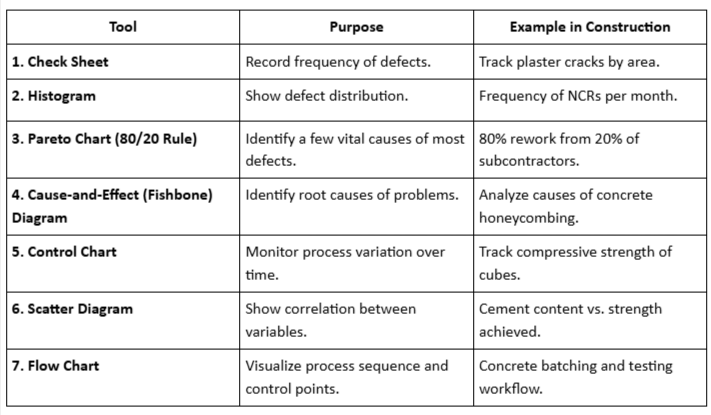
Statistical Quality Control Tools

TQM relies on quantitative methods to measure, analyze, and improve quality performance.

These are often called the Seven Basic Quality Tools (7QC Tools).

Key Metrics for Quality Control

  • Defect Rate (%): Defective work / Total inspected × 100
  • Rework Cost (%): Cost of rework / Total project cost × 100
  • First-Time Right (FTR): % of activities completed without rework
“Data transforms assumptions into actions — that’s the essence of TQM.”

Quality Audits, Training, and Supplier Involvement

1. Quality Audits

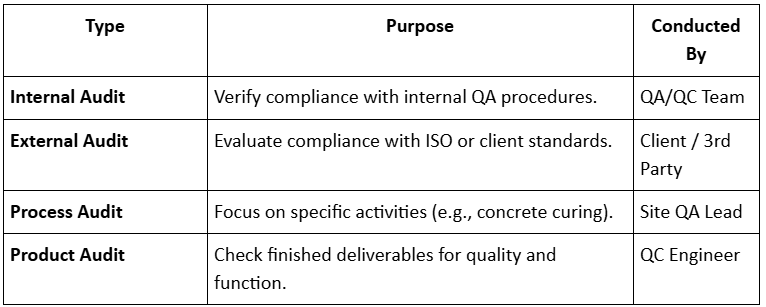
A quality audit systematically evaluates whether processes comply with standards and produce desired outcomes.

Types of Quality Audits

Types of Quality Audits

Audit Deliverables

  • Non-Conformance Reports (NCRs)
  • Corrective & Preventive Action (CAPA) Logs
  • Audit Summary & Improvement Plan

2. Quality Training Programs

  • Conduct induction sessions on project quality plans.
  • Train supervisors in inspection & test plan (ITP) procedures.
  • Refresh workers on workmanship standards and common defect prevention.
  • Use toolbox sessions and visual guides at the site for daily reinforcement.

3. Supplier Quality Involvement

  • Pre-qualify suppliers based on quality certifications (e.g., ISO 9001).
  • Include QA clauses in purchase orders and contracts.
  • Conduct supplier audits and rate them on delivery, consistency, and complaint history.
  • Develop long-term partnerships for continuous improvement.
“Quality is everyone’s job — from site worker to supplier.”

Customer Satisfaction and Continuous Improvement

In construction, customer satisfaction is not limited to handover — it begins with understanding requirements and ends with lifecycle performance.

1. Measuring Customer Satisfaction

  • Conduct Client Feedback Surveys at milestones (design, commissioning, handover).
  • Track Defect Liability Performance and response times.
  • Monitor repeat business or referrals as success indicators.
  • Use Service Level Agreements (SLAs) for measurable quality delivery.

2. The PDCA Cycle (Deming Wheel)

A foundational model for continuous improvement.

Plan → Do → Check → Act

  • Plan: Identify issues and set improvement goals.
  • Do: Implement small, measurable changes.
  • Check: Measure outcomes against benchmarks.
  • Act: Standardize successful improvements.

Example:

After recurring plaster cracks → Plan corrective training → Implement mock-up → Review results → Adopt best practices across all sites.

3. Benchmarking

Compare your organization’s performance with industry standards or competitors to identify improvement areas (e.g., defect rate per 10,000 sq. ft., safety scores, rework percentage).

“Continuous improvement isn’t a project — it’s a culture.”

Principles of TQM in Engineering Projects

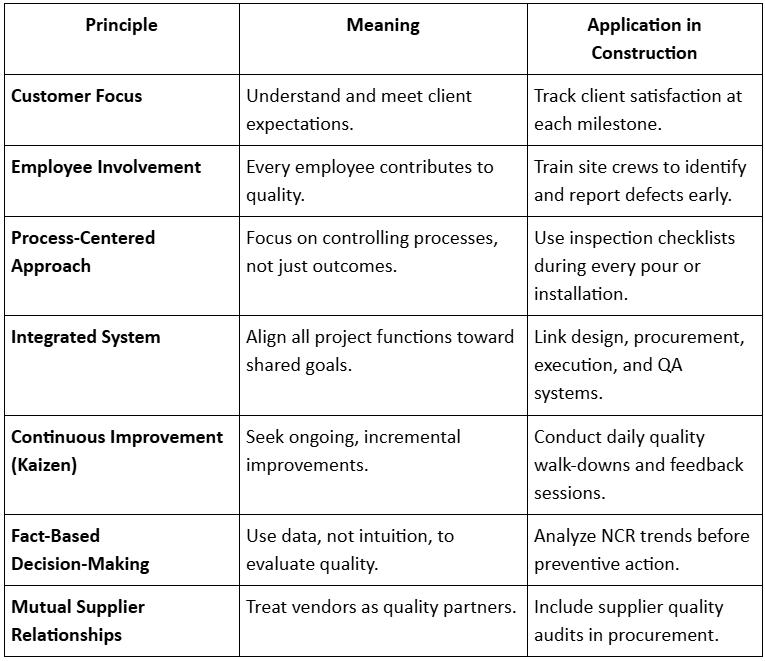
Total Quality Management (TQM) is a holistic management philosophy focused on “doing things right the first time”, ensuring customer satisfaction, and promoting long-term success through teamwork and process improvement.

1. Key Principles of TQM

Key Principles of TQM

“Quality is not an act — it’s a habit practiced daily at every level.”

Leadership Styles and Emotional Intelligence

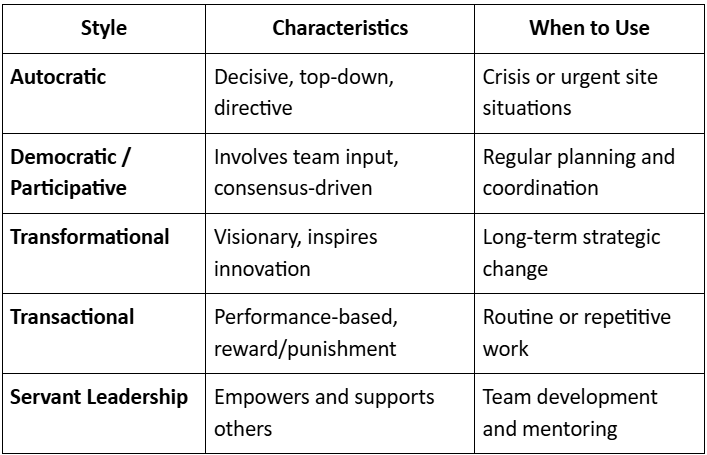
Leadership is the art of inspiring people to achieve common goals — not by authority, but by influence.

1. Leadership Styles

Leadership Styles

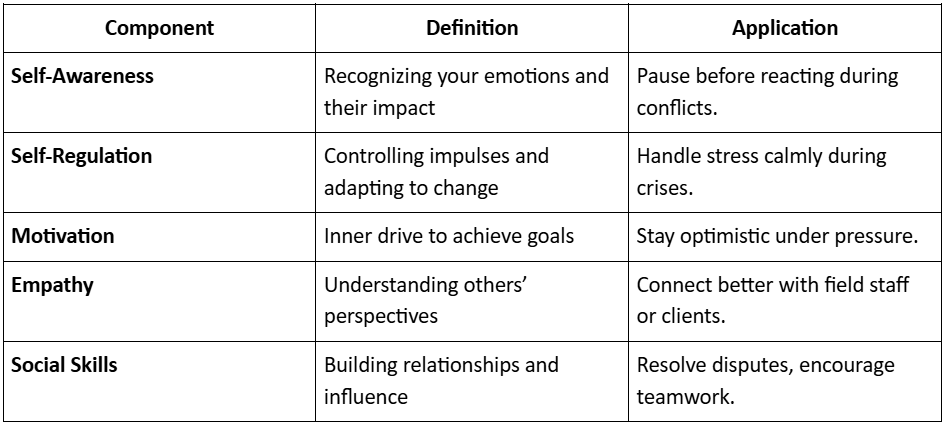
2. Emotional Intelligence (EI) Framework

Emotional Intelligence (EI) Framework

3. Developing Leadership Presence

  • Lead by example — model punctuality, integrity, and accountability.
  • Practice active listening and inclusive dialogue.
  • Provide constructive feedback — privately and positively.
  • Recognize both effort and outcome.
  • Maintain composure in pressure situations.
“Emotional intelligence turns a manager into a leader — and a group into a team.”

Module Summary

  • Time management and structured decision-making drive efficiency.
  • Motivation and behavioral insight unlock team performance.
  • Clear communication and presentation build credibility.
  • Meetings and reports must convert discussion into action.

Leadership combined with emotional intelligence sustains long-term success.

Category: Construction Academy

Subcategory: Budgeting and Planning

Subcategory: Construction Phase

Subcategory: Design Coordination

Subcategory: Estimation Techniques

Subcategory: Initiation and Feasibility

Subcategory: Introduction

Subcategory: Personal Management

Subcategory: Project Close-Out

Subcategory: Project Scheduling

Subcategory: Project Teams

Subcategory: Proposal Management

Subcategory: Total Quality Management

Subcategory: Tracking and Control

Subcategory: Work Breakdown

Category: Help Desk

Subcategory: Client

Subcategory: Construction 101

Subcategory: Contractor Management

Subcategory: Expense

Subcategory: Finance Budget

Subcategory: Inventory Management

Subcategory: My Approvals

Subcategory: Site Management

Subcategory: Vendor Management